Same facts, two different answers
I’ve been getting websites found on Google for more than 20 years. This year I ran a simple test. I searched the same set of facts about a business on Google, then asked an AI tool the same question. The answers didn’t match. Not slightly off. Completely different.
That sent me on a few weeks of digging. One of the first things I learned was humbling. When ChatGPT added search, much of what it found came from Bing’s index. Bing. The search engine most of us in the web business stopped thinking about years ago, back when Google owned nearly all of search.
I wasn’t alone. Ask most web developers when they last checked a client’s site in Bing Webmaster Tools. For a lot of them, the honest answer is never.
It’s not just Bing. It’s everywhere.
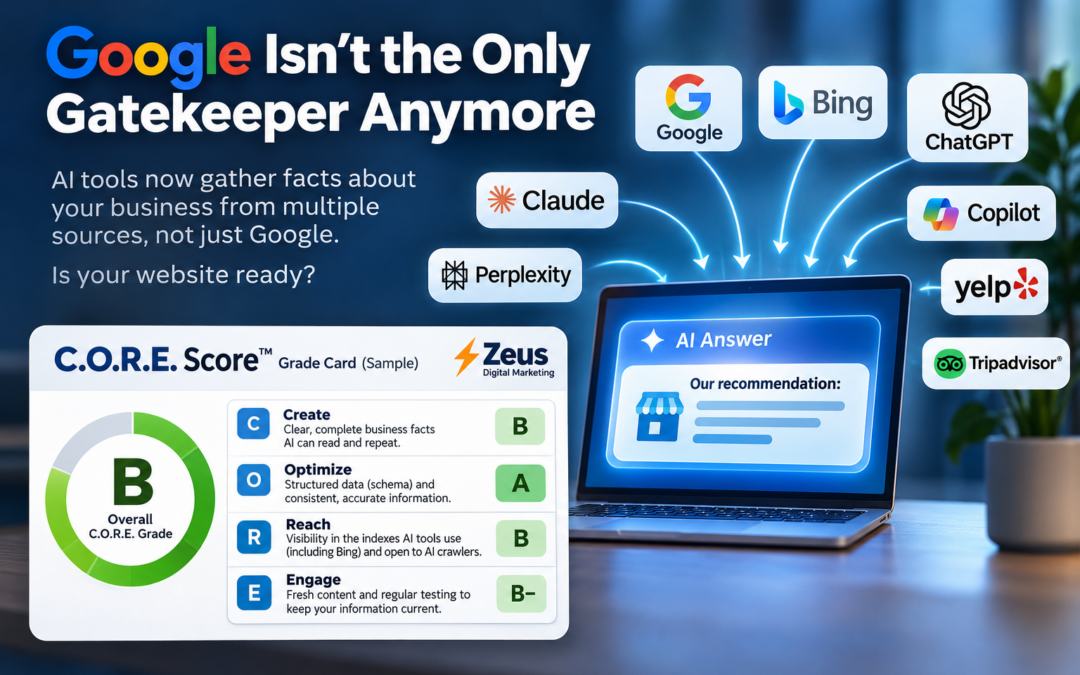
Bing turned out to be only part of the story. Recent research shows ChatGPT now pulls from its own index, from Google results, from Bing, and from review sites like Yelp and TripAdvisor. Google’s AI answers draw from Google. Claude, Perplexity and Copilot each have their own mix.
For a business owner, the takeaway is simple: ranking on Google is no longer the finish line. AI tools gather facts about your business from many places, then decide whether to recommend you. If your website is hard for them to read, or your facts don’t match from one place to the next, they recommend someone else. Or worse, they describe you wrong.
That’s the part that matters most. A traditional search shows a list of links and lets the customer choose. An AI answer makes the choice for them.
C.O.R.E. still works. It just goes deeper now.
I built the C.O.R.E.™ framework in 2012: Create, Optimize, Reach, Engage. It was built for Google. Fourteen years later it fits AI discoverability better than anything I could invent today, because getting found by AI runs on the same principles as SEO, just deeper.
- Create. AI tools need facts they can read and repeat: who you are, what you do, where you are, and answers to the questions your customers actually ask. In plain text, not buried in images.
- Optimize. Structured data (schema) tells AI exactly what your business is. And your facts need to match everywhere they appear: your website, your Google Business Profile, the directories.
- Reach. Your site has to be in the indexes AI draws from, Bing included, and open to the AI crawlers that read it.
- Engage. AI favors current information. Fresh content and regular testing keep you in the answers.
Your C.O.R.E. Score
To show business owners where they stand, we built the C.O.R.E. Score: a grade card for your website’s search and AI readiness. Your site gets a letter grade on each of the four pillars, plus an overall grade, A through F.
The grade card answers the questions a business owner actually cares about. Can AI tools find my site? Can they understand what I do? Do my facts match across the web? Is my information current?
What it doesn’t include is a do-it-yourself repair manual. Fixing what the grade card finds takes hours of hands-on work per site. That’s what we do.
Audit. Fix. Assurance.
Getting a site ready for AI takes three steps.
- Audit. We review your site for both traditional SEO and AI readiness, and you get your C.O.R.E. Score. The audit is the starting point for everything that follows.
- Fix. Our AI Discovery Package covers everything the audit checks. That means a bit of a makeover where needed, plus the content and structured data AI tools need to recommend your business. It’s a one-time project, with a before-and-after AI test so you can see the difference.
- Assurance. AI tools change fast. Our SEO & AI Assurance plan keeps watch with regular testing of how AI tools answer questions about your business, and adjustments when something slips.
Find out where you stand
Try this today. Ask ChatGPT, Claude or Google’s AI to recommend a business like yours in your area. Then ask it about your business by name. If you don’t like the answer, or you don’t show up at all, contact Zeus Digital Marketing and ask for your C.O.R.E. Score.
[Request your C.O.R.E. Score →]
Frequently asked questions
Does ChatGPT use Google or Bing? Both, and more. ChatGPT combines its own index with results from Google, Bing and other sources, including review sites. Being visible in only one leaves gaps.
If my site ranks well on Google, am I covered for AI? Not necessarily. AI tools read and weigh information differently than a page of search results. A site can rank on Google and still be skipped, or described wrong, in an AI answer.
What is the C.O.R.E. Score? A grade card from Zeus Digital Marketing that rates a website’s readiness for search engines and AI tools across four areas: Create, Optimize, Reach and Engage.
What is schema? Code added to a website that labels key facts, such as business type, location, products and events, so search engines and AI tools can read them without guessing.
How long does it take to fix a site? It depends on the site. Every project starts with the audit, which shows how much work is needed.
What if my site isn’t built on WordPress? We’ll review it. In many cases, a rebuild is the better investment.
Sources
- ChatGPT built its own search index, Peec, Sep 2026
- ChatGPT Search makes Microsoft Bing an SEO priority, Search Engine Land