
By Jeff Gilder
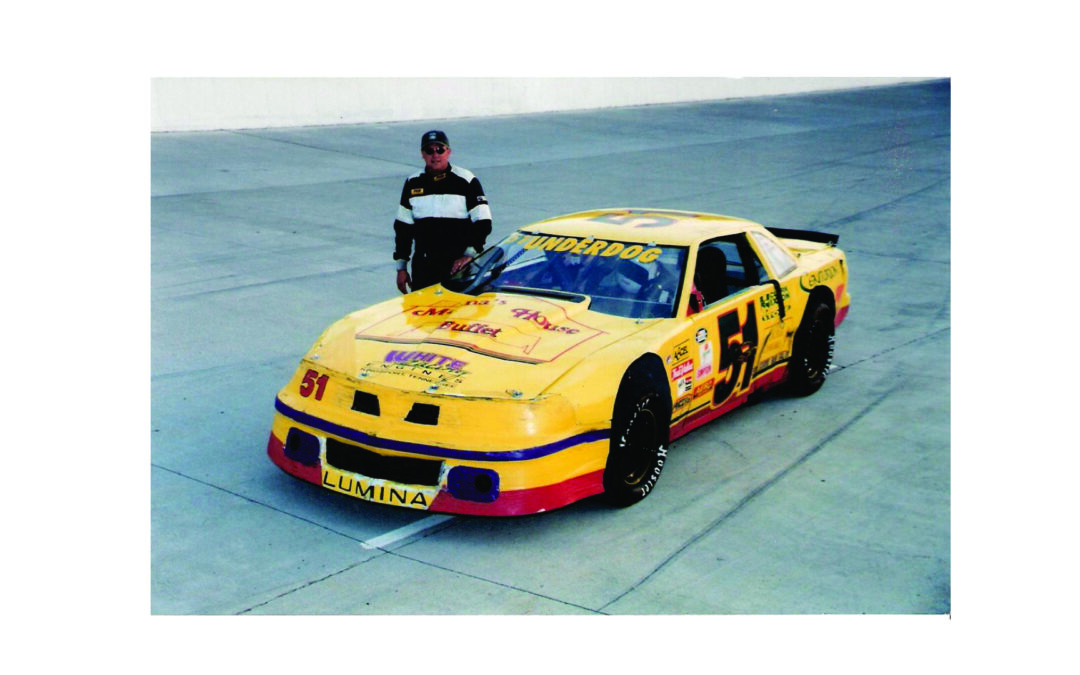
I used to race stock cars.
Not as a career. More of a serious hobby — the kind where you tell yourself it’s just for fun, but then you find yourself in the shop every night at 10 PM covered in grease, chasing a tenth of a second.
I started on dirt tracks, running stock cars the old-fashioned way. Loud. Loose. Unpredictable. I did well — won a couple of races, finished in the top five more than 20 times. Enough success to be dangerous. Enough to think I knew what I was doing.
Then I set a goal that changed everything: I wanted to race in NASCAR-sanctioned events on pavement.
Different car. Different surface. Different world.
That decision led me to a man named Paul Lewis. And Paul Lewis — more than any business book, any seminar, any mentor I’ve had in marketing or media — taught me how to compete, how to win, and more importantly, how to keep winning.
The Goals That Scared Me a Little
Before my first pavement season, Paul sat me down and told me to set goals. Not safe goals. Real ones.
I wrote down what I wanted:
- Win 10 races
- Set the track record
- Sit on the pole (fastest qualifier) 10 times
- Win the championship
These weren’t modest aspirations for someone who had never turned a lap in a late model stock car on asphalt. Paul knew that. He didn’t flinch.
At the end of that season, I had won 13 races, sat on 15 poles, set the track record — then broke my own record — and won both the track championship and the NASCAR-sanctioned championship. In 25 races.
None of that happened because I was talented. It happened because of three things Paul drilled into me. I call them Paulisms. I use them every single day.
Paulism #1: “If you stop getting better, you cease being good.”
After I won my sixth race in a row, I’ll be honest — I was feeling pretty good about myself. Maybe a little too good.
Paul noticed.
He didn’t yell. He didn’t make a big scene. He just looked at me after practice one evening and said it matter-of-factly, like he was reading the weather:
“If you stop getting better, you cease being good.”
It stopped me cold.
I thought winning meant I had arrived. Paul was telling me that winning is the moment you’re most at risk — because complacency is invisible. It sneaks in dressed as confidence.
In business, I see this constantly. Companies win a few accounts, get comfortable, stop sharpening their systems, stop studying the market — and slowly, quietly, they fall behind. They don’t fail dramatically. They just stop being as good as they used to be, and they wonder why.
The standard isn’t standing still. What it takes to win today won’t be enough tomorrow.
Paulism #2: “There’s not a single thing you can do to make you a champion.”
Midseason. Things were going well. I walked into the shop expecting encouragement.
Paul looked at me and said: “There’s not a single thing you can do to make you a champion.”
I went quiet. My stomach dropped. Was he telling me I wasn’t good enough?
Then came the pause — what I’d later describe as one of the most valuable pauses of my life.
“There are a hundred little things. And all of them add up.”
Then he handed me a wrench and put me to work.
That’s not a metaphor. We worked in that shop every night after my regular workday — adjusting, refining, testing, tweaking. Suspension geometry. Weight distribution. Tire pressure. Fuel load. A hundred details that each individually did almost nothing, but together created an edge that the competition couldn’t explain and couldn’t replicate.
The reason most people lose isn’t one big mistake. It’s the accumulation of small things they decided weren’t worth their attention.
At Zeus Digital, this is how we build marketing systems. There is no one magic tactic. There’s no silver bullet keyword, no perfect ad, no single social post that changes everything. There’s a hundred little things — the site architecture, the copy precision, the targeting logic, the follow-up sequence, the reputation signals — that compound into something the competition can’t touch.
Champions are built in the details. Every time.
Paulism #3: Whatever it takes. Never give up.
Paul didn’t hang this one on a poster. He modeled it.
He showed up. Every night. Wrenches in hand. No recognition. No championship ring with his name on it. Just an absolute refusal to let a problem go unsolved or a car leave the shop in anything less than its best possible condition.
That standard became contagious.
You can’t race a stock car at 100 miles an hour on a dirt-covered track and give partial effort. The car knows. The track knows. The other drivers waiting for you to make a mistake — they know.
Halfway doesn’t work in racing. And in my experience, it doesn’t work in business either.
What 50 Races Taught Me That a Decade in Business Confirmed
My racing career lasted about 50 races total — dirt and pavement combined. Brief by any measure. But dense with lessons I’ve carried into every business I’ve built since.
WingDing®. Zeus Digital. ULD. The work we do for clients every day. All of it runs on the same principles Paul Lewis taught me in a small racing shop in east Tennessee somewhere between practice sessions and championship nights.
Set goals that scare you a little. Do the hundred little things. Never stop getting better. Never give up.
Paul passed away last year. He’ll never read this.
But I’ll remember what he gave me every single day — and I’ll keep trying to be worthy of it.
Jeff Gilder is the founder of WingDing®, a connected streaming and distribution ecosystem, and Zeus Digital Marketing, a full-service digital agency based in the Myrtle Beach area. He has spent more than two decades building brands, platforms, and marketing systems that create lasting momentum.