
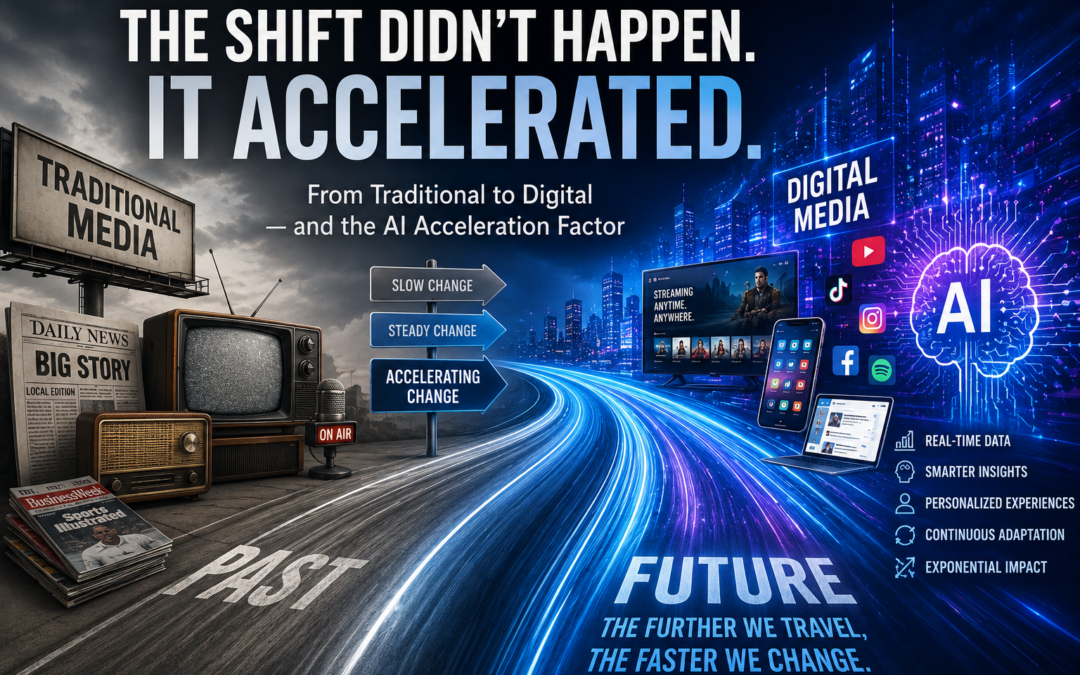
There was a time—not that long ago—when the debate was simple:
Traditional media vs. digital media
TV vs. streaming
Radio vs. podcasts
Print vs. web
That debate is over.
Not because one “won.”
But because the pace of change didn’t stay linear.
It accelerated.
The Mistake Everyone Made
For years, the industry treated change like this:
Slow → steady → predictable
So decisions were made accordingly:
- protect legacy spend
- test digital cautiously
- “wait and see” on new platforms
Even as companies like Facebook and YouTube exploded, many advertisers assumed they had time.
They didn’t.
The Reality: Change Compounds
What we’re experiencing now isn’t a shift.
It’s a compounding effect.
Every layer of technology builds on the last:
- faster internet
- better devices
- smarter platforms
- more content
- more data
And now—artificial intelligence.
Each layer doesn’t just add change.
It multiplies it.
The Acceleration Effect
Here’s the part most people underestimate:
The further we move into digital, the faster everything changes.
Not incrementally.
Exponentially.
What took:
- 10 years to change… now takes 3
- 3 years… now takes 12 months
- 12 months… now takes a quarter
And shrinking.
Traditional Media Didn’t Die. It Slowed Down.
Let’s be clear:
Traditional media still exists.
- TV still reaches audiences
- radio still has listeners
- print still has niches
But…
It no longer sets the pace.
It reacts to it.
Digital Didn’t Replace Traditional. It Redefined It.
Digital didn’t just take budget.
It changed expectations.
Audiences now expect:
- on-demand access
- personalized content
- multi-device experiences
- continuous engagement
And most importantly:
Relevance.
Enter AI: The Acceleration Multiplier
If digital accelerated media…
AI is accelerating digital.
Tools powered by AI are now:
- generating content
- optimizing campaigns
- predicting behavior
- automating decisions
At a scale that wasn’t possible even two years ago.
But here’s the key:
AI doesn’t slow things down. It speeds everything up.
The Hidden Risk
Many businesses are making the same mistake again:
treating AI like a feature instead of a force
Just like early digital.
They’re:
- experimenting cautiously
- waiting for clarity
- assuming stability
Meanwhile, the pace continues to increase.
What This Means for Marketing
The old model was:
create → place → wait → measure
The new reality is:
create → distribute → adapt → repeat
Continuously.
Because attention doesn’t sit still anymore.
The Real Divide
This isn’t about traditional vs. digital anymore.
It’s about:
static vs. adaptive
Businesses that rely on:
- fixed campaigns
- fixed channels
- fixed timelines
are operating in a slower system.
Businesses that embrace:
- continuous distribution
- real-time adjustment
- audience-driven strategy
are operating at the speed of the market.
The Bottom Line
The transition from traditional to digital didn’t happen gradually.
It accelerated.
And now AI is accelerating the acceleration.
The question isn’t:
“Should we move to digital?”
That decision is already behind us.
The real question is:
“Are we operating at the speed of change—or reacting to it?”
Because the gap between those two is widening.
Fast.
How about you? Are you operating at the speed of change?